Have you ever opened a mobile app and found it so easy to use that you barely had to think about what to do next? Or visited a website where everything, from the navigation to the buttons and layout, felt perfectly organised? That experience is not accidental. It is the result of thoughtful UI/UX design.
Today, websites, mobile applications and digital products are an important part of everyday life. Businesses want their digital platforms to look attractive while also making them simple and convenient to use. This has created opportunities for people who understand design, creativity and user behaviour.
If you enjoy creativity, problem-solving and technology, UI/UX design could be a career path worth exploring. Whether you are a student, fresher, graphic designer or working professional, enrolling in a structured UI/UX design program in Mumbai can help you develop the skills required to enter this field.
Let’s understand what UI/UX design involves, what you need to learn and how you can move from beginner to professional designer.
What Is UI/UX Design and Why Is It Important?
UI and UX are two connected areas of digital product design, but they focus on different aspects of the user’s experience.
UI (User Interface) Design focuses on the visual elements of a website or application. It includes colours, typography, buttons, icons, images, layouts and other elements users interact with.
UX (User Experience) Design focuses on how people experience a website, application or digital product. It involves understanding user needs, identifying problems and making digital experiences easier and more convenient.
For example, imagine using a food delivery application. The colours, icons, buttons and visual arrangement are part of UI design. The ease of searching for restaurants, selecting food, making payments and tracking an order comes under UX design.
Both work together to create digital products that are visually appealing and easy to use.
Why Should You Consider Learning UI/UX Design in Mumbai?
Mumbai has businesses across industries such as finance, entertainment, education, retail, technology and e-commerce. Many of these businesses depend on websites, mobile applications and digital platforms to interact with customers.
This makes design skills relevant across different types of organisations.
Learning UI/UX design can be a good option if you:
Enjoy creativity and visual communication.
Like understanding how people think and behave.
Are interested in websites, mobile apps and technology.
Enjoy solving problems and improving existing ideas.
Want to explore a career beyond traditional graphic design.
You do not necessarily need to know coding or have a design background to begin. A genuine interest in learning and a willingness to practise are good starting points.
What Will You Learn in a UI/UX Design Course?
A good UI/UX design course should take you through the complete design process rather than focusing only on making attractive screens.
Here are some important areas beginners should understand.
1. Introduction to UI/UX and Human-Centred Design
Start by understanding the fundamentals of user experience, user interface and human-centred design.
You will learn why users behave differently, how people interact with digital products and why a design should be created around actual user needs.
2. User Research and Discovery
Before designing a website or application, designers need to understand the people who will use it.
User research helps identify customer expectations, problems and preferences. It may involve interviews, surveys, contextual inquiry and competitor analysis.
This stage helps designers make decisions based on user needs rather than assumptions.
3. Ideation and Design Strategy
Once the problem is understood, designers explore possible solutions.
Techniques such as empathy maps, scenarios and experience maps help organise ideas and understand the user’s journey.
The aim is to identify opportunities and develop solutions that are useful and practical.
4. Information Architecture and Wireframing
Information architecture focuses on organising information so users can find what they need easily.
Wireframes are basic layouts that show how a website or application screen will be structured before the final visual design is created.
You may learn about site maps, user journeys, task flows and different wireframing approaches.
5. Visual Design, Colours and Typography
This is where the visual side of UI/UX becomes important.
Designers need to understand how colours, fonts, spacing, layouts and visual hierarchy influence the way people interact with a digital product.
A well-organised interface should communicate information clearly without overwhelming the user.
6. Prototyping and Interactions
Prototyping allows designers to create an interactive version of a website or application before development begins.
You can explore how buttons, menus, transitions and other elements work together. It also helps identify usability issues before the product is built.
7. Responsive and Mobile Design
People use digital platforms across smartphones, tablets, laptops and desktops. Designers need to understand how layouts adapt to different screen sizes.
Learning responsive and adaptive design principles helps you create experiences that remain convenient across devices.
Which Tools Should an Aspiring UI/UX Designer Learn?
Design tools help transform ideas into wireframes, interfaces and interactive prototypes. Some commonly used tools introduced in UI/UX training include:
Figma: Used for interface design, collaboration and prototyping.
Sketch: A tool for creating digital interface designs.
Axure RP: Used for wireframing and interactive prototypes.
Balsamiq: Useful for creating low-fidelity wireframes.
Zeplin: Helps organise and hand over design specifications to developers.
The tools you use may vary depending on the project and organisation. More importantly, understand the design principles behind them. Learning software alone will not make you a strong UI/UX designer.
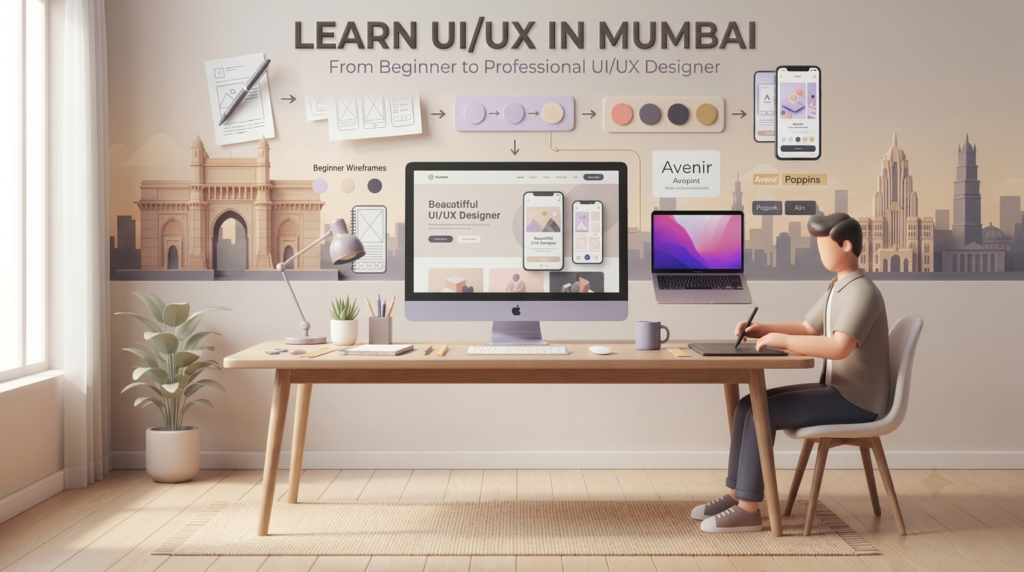
How Can You Move from a Beginner to a Professional UI/UX Designer?
Becoming a professional designer takes more than completing a course. It requires consistent practice, feedback and the ability to explain your design decisions.
Here is a simple learning path:
Step 1: Understand the fundamentals. Learn UI, UX, user research, design thinking and visual design principles.
Step 2: Practise using design tools. Start with wireframes, layouts and simple prototypes using tools such as Figma.
Step 3: Work on design projects. Try redesigning an existing app screen, creating a website layout or solving a simple user-experience problem.
Step 4: Learn to accept feedback. Review your work, identify usability issues and improve your designs based on feedback.
Step 5: Build a portfolio. Present your projects with the problem, research, design process, wireframes and final solution. A portfolio helps employers understand how you think and approach design challenges.
This gradual approach can help you develop both technical knowledge and creative confidence.
Explore the UI/UX Design Program at IIEDM Mumbai
If you are searching for UI UX courses near me or exploring a structured UI/UX design program in Mumbai, IIEDM offers a three-month UI/UX Design Certification Course.
The programme is designed to introduce learners to the different stages of UI/UX design, from understanding user behaviour to creating interfaces and presenting design projects.
The curriculum includes:
User research, discovery and ideation.
Empathy maps and experience maps.
Information architecture and wireframing.
UX writing and visual design.
Colour theory and typography.
Figma, Sketch and other design tools.
Prototyping and interactions.
Responsive and mobile design.
Portfolio development and presentation.
Mock interviews and feedback.
The programme also includes portfolio progress and interview presentation sessions to help learners prepare to showcase their work.
IIEDM’s course page highlights industry faculty and the experience of The Brand Saloon, its associated digital marketing agency, as part of its training approach.
The course is open to beginners, students, freshers, graphic designers, web designers, app developers and working professionals interested in learning UI/UX.
What Career Opportunities Can You Explore After a UI/UX Course?
After developing your design knowledge and building a portfolio, you can explore different entry-level opportunities in the design industry.
Some career options include:
UI Designer: Focuses on the visual appearance and layout of websites and applications.
UX Designer: Works on improving usability and the overall experience of digital products.
Product Designer: Works on solving user problems through the design of digital products.
UX Researcher: Studies user behaviour and gathers insights to improve product experiences.
Interaction Designer: Focuses on how users interact with interface elements and digital products.
Your career opportunities will depend on your portfolio, practical skills, experience and ability to explain your design decisions during interviews.
Where Can You Find UI/UX Training at IIEDM in Mumbai?
IIEDM has centres in different parts of Mumbai, making it possible for learners to enquire about training options at a convenient location.
The institute lists the following centres:
Charni Road: 1601, 16th Floor, Panchratna, Opera House, Charni Road,
Mumbai – 400004.
Contact IIEDM to confirm course availability, batch timings, fees and admission details at your preferred centre.
Start Your UI/UX Design Journey with IIEDM
UI/UX design brings together creativity, research, technology and problem-solving. It is not simply about making a website or application look attractive. It is about understanding people and creating digital experiences that make their lives easier.
If you are exploring UI UX courses near me or want to join a UI/UX design program in Mumbai, take the time to understand the syllabus, tools, practical assignments and portfolio support offered by the institute.
With its three-month certification programme, industry-oriented curriculum, design tool exposure and portfolio development sessions, IIEDM can be an option to consider as you begin your UI/UX learning journey.
Start with the basics, practise regularly and keep improving your designs. Every project you work on can help you take one step closer to becoming a confident UI/UX designer.