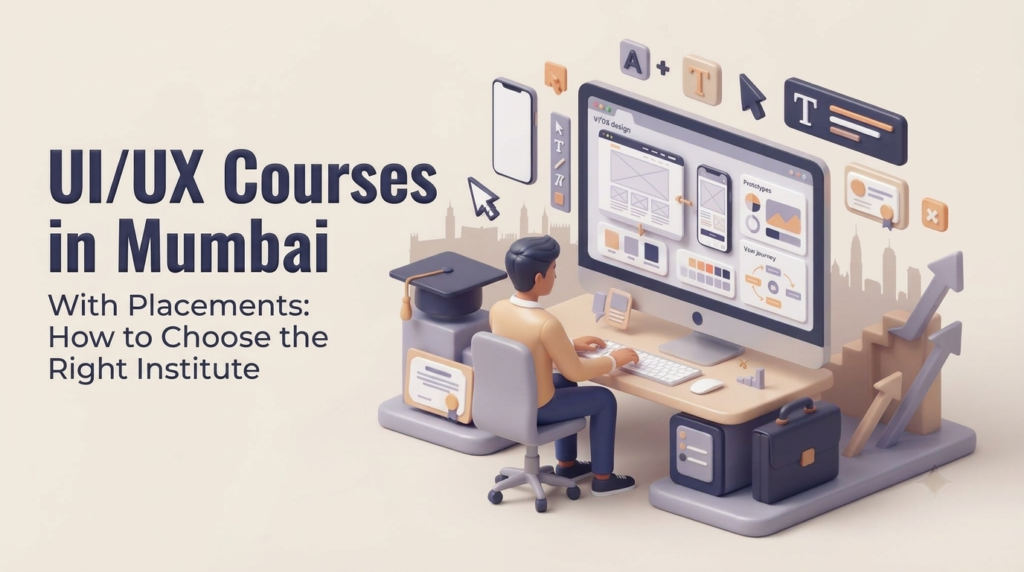
Looking to build a career in UI/UX design? Discover what to check before enrolling, from practical training and industry-relevant tools to portfolio development and placement assistance.
Choosing a career today is not just about getting a degree or completing a course. It is about developing skills that companies actually look for. With businesses investing heavily in websites, mobile applications and digital platforms, UI/UX design has become an interesting career option for students, fresh graduates and working professionals.
As a result, the demand for UI/UX courses in Mumbai with placements has increased among individuals who want to enter the design industry with the right training and career guidance.
However, finding an institute that offers a course is easy. Finding one that focuses on practical learning, industry exposure, portfolio development and placement assistance requires a little more research.
If you are planning to enrol in a UI/UX design course in Mumbai, here is a guide to help you understand what to look for before selecting the right institute.
1. Understand What UI/UX Design Actually Involves
Before choosing a UI/UX training institute, it is important to understand what you will be learning.
UI stands for User Interface, while UX stands for User Experience. Both are essential parts of creating successful digital products.
UI Design (User Interface) focuses on the visual appearance of websites and applications. It includes colours, typography, layouts, buttons, icons and other interactive elements.
UX Design (User Experience) focuses on how users interact with a digital product. It involves understanding user behaviour, identifying problems and creating convenient digital experiences.
For example, when you open a shopping application, the attractive product layouts and buttons are part of UI design. The ease of searching for products, adding items to your cart and completing a payment comes under UX design.
A good UI/UX design course in Mumbai should help you understand both areas and teach you how to apply them while creating digital experiences.
2. Look for an Industry-Relevant Course Curriculum
One of the first things you should check before enrolling is the course syllabus.
A well-designed programme should cover the complete UI/UX design process, from understanding user requirements to developing interactive prototypes.
Here are some important topics your course should include:
User Research: Understanding customer behaviour through interviews, surveys and competitor analysis.
Design Thinking: Identifying problems and developing user-focused solutions.
Wireframing: Creating basic layouts and structures for websites and applications.
Information Architecture: Organising digital content and navigation.
Visual Design: Learning colour theory, typography, layouts and design principles.
Prototyping: Creating interactive models of websites and mobile applications.
Usability Testing: Identifying design problems and improving user experiences.
Portfolio Development: Showcasing your design projects and creative abilities.
At IIEDM, the UI/UX Design Certification Course covers modules such as user research, discovery, ideation, information architecture, wireframing, UX writing, visual design, prototyping and portfolio development.
This allows students to understand different stages of the design process instead of learning only the visual aspects.
3. Check Whether the Institute Provides Practical Training
UI/UX design is a skill-based profession. Simply understanding design theories is not enough to prepare yourself for a professional role.
Before selecting a UI/UX design institute in Mumbai, check whether students get opportunities to work on practical assignments, projects and real-world design problems.
Practical training helps you:
Understand how to approach a design problem.
Create website and mobile application layouts.
Develop wireframes and prototypes.
Identify usability issues.
Apply design principles to real situations.
Improve your problem-solving abilities.
For example, redesigning a food delivery application can help you understand how to improve navigation, simplify the ordering process and create a better customer experience.
The more opportunities you get to practise, the more confident you become when presenting your work to potential employers.
4. Learn Industry-Relevant UI/UX Design Tools
Another important factor is the software and tools covered in the programme.
Companies expect designers to understand commonly used design platforms and know how to apply them effectively.
Some popular UI/UX tools include:
Figma: Used for designing interfaces, creating prototypes and collaborating with design teams.
Sketch: A popular tool for creating website and application interfaces.
Balsamiq: Helps designers develop basic wireframes and visualise layouts.
Axure RP: Used for building interactive prototypes and complex user flows.
Zeplin: Helps designers share design specifications and collaborate with developers.
When comparing UI/UX courses in Mumbai with placements, check whether the institute offers practical exposure to these tools.
At IIEDM, the curriculum introduces students to tools such as Figma, Sketch, Axure RP, Balsamiq, Zeplin and InVision.
Understanding these platforms can help you develop the technical confidence needed to work on design projects.
5. Portfolio Development: An Important Step Towards Getting Hired
One of the biggest mistakes aspiring designers make is focusing only on completing the course and receiving a certificate.
In the UI/UX industry, your portfolio plays an important role in demonstrating your capabilities.
A portfolio gives employers an understanding of how you think, approach problems and develop design solutions.
A strong beginner portfolio can include:
Website redesign projects.
Mobile application interface designs.
User personas and research findings.
Wireframes and interactive prototypes.
User journey maps.
Design case studies explaining your decisions.
Before enrolling, check whether the institute provides proper guidance on creating and presenting a professional portfolio.
IIEDM includes portfolio design, portfolio progress, interview presentation and mock interviews in its UI/UX curriculum.
This helps students understand how to showcase their projects and communicate their design decisions during job interviews.
6. Understand What Placement Assistance Actually Means
This is probably the most important factor for students searching for UI/UX courses with placements in Mumbai.
Many institutes advertise placement support, but it is important to understand what that support includes.
Before enrolling, ask the institute about:
Whether it has an active placement team.
Whether students are connected with hiring companies.
Whether resume-building assistance is provided.
Whether mock interviews are conducted.
Whether portfolio reviews are included.
Whether placement opportunities are available for freshers.
Whether any eligibility conditions apply.
Remember, placement assistance and a guaranteed job are not necessarily the same thing. Your skills, portfolio, interview performance and the opportunities available will also influence your career outcome.
At IIEDM, placement opportunities and career preparation are highlighted as part of its training approach. The institute also includes portfolio presentations and mock interview preparation in its UI/UX programme.
Students should contact the admissions team to understand the current placement process, eligibility criteria and applicable terms.
7. Compare Course Duration, Fees and Learning Flexibility
Course duration and fees are equally important when selecting the right institute.
Before making a decision, compare what each programme offers rather than choosing based only on its price.
| Factors | What You Should Check |
|---|---|
| Course duration | Whether all essential topics are covered |
| Course fees | Complete fees and additional charges |
| Learning mode | Online, offline or hybrid |
| Batch timings | Weekday and weekend availability |
| Certification | Certificate details |
| Practical training | Projects and assignments |
| Career support | Interview and placement assistance |
At IIEDM, the UI/UX Design Certification Course has a duration of three months, with weekday and weekend learning options.
For the latest fees, upcoming batches and admission details, students can directly contact the institute.
8. Why Consider IIEDM for UI/UX Courses in Mumbai with Placements?
If you are searching for a career-focused UI/UX design institute in Mumbai, IIEDM is worth exploring.
IIEDM offers a three-month UI/UX Design Certification Course that introduces students to the fundamentals of user experience, interface design and industry-relevant tools.
Here are some features of the programme:
Industry-Oriented Curriculum: Learn user research, ideation, wireframing, visual design, information architecture and prototyping.
Practical Tool Exposure: Get introduced to Figma, Sketch, Axure RP, Balsamiq and other design tools.
Portfolio Development: Learn how to create and present design projects professionally.
Interview Preparation: Develop confidence through portfolio presentations and mock interview sessions.
Placement Support: Explore career opportunities through the institute’s placement assistance.
Convenient Mumbai Locations: IIEDM has centres in Dadar, Malad and Charni Road, making its programmes accessible to students from different parts of Mumbai.
Whether you are a beginner, a fresh graduate or someone looking to transition into the design industry, IIEDM provides a structured learning programme to help you develop your UI/UX design skills.
9. Career Opportunities After Completing a UI/UX Course
Once you develop the necessary skills and build a strong portfolio, you can explore different career opportunities in the design industry.
Some popular job roles include:
UI Designer: Creates the visual layouts and interfaces of websites and applications.
UX Designer: Focuses on improving the overall user experience.
Product Designer: Works on the design and functionality of digital products.
UX Researcher: Studies user behaviour and identifies areas for improvement.
Interaction Designer: Designs how users interact with digital platforms.
Your career growth will depend on your practical knowledge, portfolio quality, experience and ability to solve design problems.
Frequently Asked Questions
Q1. Which institute offers UI/UX courses in Mumbai with placement assistance?
IIEDM offers a UI/UX Design Certification Course in Mumbai, with placement opportunities and interview preparation as part of its career support approach.
Q2. What is the duration of the UI/UX course at IIEDM?
The UI/UX Design Certification Course at IIEDM is three months long, with weekday and weekend options.
Q3. Do UI/UX courses require coding knowledge?
No. Coding is not compulsory to begin learning UI/UX design. However, basic technical knowledge can be helpful when working with developers.
Q4. What are the job opportunities after completing a UI/UX course?
You can explore roles such as UI Designer, UX Designer, Product Designer, UX Researcher and Interaction Designer.
Q5. Does IIEDM provide placement assistance after the course?
IIEDM highlights placement opportunities and career support for its students. Contact the institute to understand the current placement process and eligibility requirements.
Conclusion
Choosing the right UI/UX institute is an important step towards building a career in the design industry. While course fees and certificates matter, practical training, industry-relevant tools, portfolio development and placement assistance should be your main priorities.
If you are exploring UI/UX courses in Mumbai with placements, take the time to compare different programmes and understand what each institute offers.
With its three-month certification programme, practical curriculum, portfolio development and interview preparation, IIEDM is an option worth considering for aspiring UI/UX designers.
Ready to begin your UI/UX design journey? Connect with IIEDM today to explore course details, fees, upcoming batches and placement assistance.