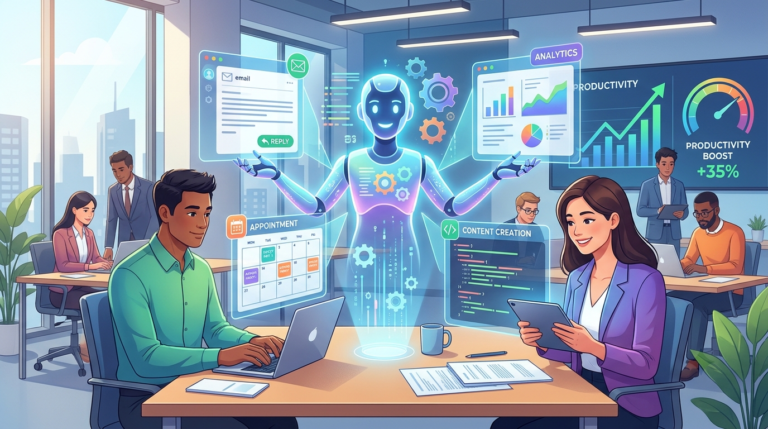

Generative AI is changing the way people create content, design visuals, analyse information, and solve everyday problems. From generating social media campaigns to developing chatbots, AI tools are giving students new ways to turn ideas into practical projects.
However, simply knowing how to use an AI tool may not be enough to stand out in the job market. Employers and clients also want to see how you apply your knowledge, solve problems, think creatively, and improve the final output.
This is where generative AI projects become valuable. By working on practical assignments, students can build an AI portfolio that demonstrates their skills beyond certificates and theoretical knowledge.
Whether you are a college student, a fresher, a digital marketing learner, or someone exploring AI, here are seven AI projects for students that can help you develop practical experience and strengthen your portfolio.
Why Are Generative AI Projects Important for Students?
Learning about AI introduces you to new tools and possibilities, but working on projects helps you understand how to use them effectively.
For example, generating a social media caption is a simple task. Developing a complete social media campaign using AI involves understanding the target audience, selecting content formats, creating suitable visuals, maintaining brand consistency, and evaluating the final output.
A well-documented project can demonstrate:
- Your ability to use AI tools for practical tasks.
- Your creativity and problem-solving skills.
- Your understanding of a specific industry or audience.
- Your ability to review, fact-check, and improve AI-generated content.
- Your readiness to apply your knowledge in an internship or entry-level role.
The goal is not to create the most complicated project. It is to show that you can use technology thoughtfully to achieve a clear objective.
7 Generative AI Projects for Students to Try
1. Create an AI-Powered Social Media Marketing Campaign
If you are interested in digital marketing, this is a great starting point. Choose a fictional brand, such as a café, clothing label, fitness studio, or skincare business. Develop a social media campaign using generative AI tools to support brainstorming, content creation, and visual planning.
What you can include:
- A target audience and brand overview.
- A 15-day or 30-day content calendar.
- Instagram captions, carousel concepts, and Reel scripts.
- AI-assisted visual concepts for selected posts.
- A campaign theme, hashtags, and calls to action.
You can use tools such as ChatGPT or Google Gemini for brainstorming and writing assistance, alongside suitable design tools for visuals.
What this project demonstrates: Content planning, audience understanding, creative thinking, and the practical use of AI in social media marketing.
2. Build an AI Chatbot for Customer Support
Businesses often receive repeated questions about product details, delivery, pricing, appointments, and services. A chatbot can help organise answers to common queries and improve access to information.
For this project, create a simple chatbot concept for an online store, educational institute, or local business.
What you can include:
- A list of frequently asked questions.
- Clear, helpful responses to each question.
- A conversation flow for common customer situations.
- A prototype using a suitable no-code chatbot platform or AI application builder.
- A testing report showing how the chatbot handles different questions.
Make sure the chatbot knows when to direct users to a human representative instead of inventing an answer.
What this project demonstrates: Customer-focused thinking, conversation design, workflow planning, and an understanding of how AI can support business operations.
3. Develop an SEO-Friendly Blog Using AI Assistance
Content creation is one of the most accessible ways for students to experiment with Generative AI. However, a strong blog requires more than asking an AI tool to write an article.
Choose a topic in an area you understand, such as education, travel, technology, or digital marketing. Use AI to assist with research planning, outlining, and editing while keeping fact-checking and editorial decisions under your control.
What you can include:
- Keyword research and search intent.
- A structured blog outline with headings and subheadings.
- A researched, original article.
- A meta title and meta description.
- Relevant internal links and suggested visuals.
A final editing checklist covering accuracy, readability, and originality. For example, you could create an article explaining how small businesses can use AI in their marketing activities.
What this project demonstrates: SEO fundamentals, content strategy, research, editing, and responsible AI-assisted writing.
4. Design an AI-Assisted Advertising Creative
Advertising requires both a strong idea and an understanding of the audience. Generative AI can help students explore different creative directions before choosing and refining the best concept.
Select a product or service and develop an advertising campaign for a platform such as Instagram, Facebook, or Google Ads.
What you can include:
- A campaign objective and audience profile.
- Three different advertising concepts.
- Multiple headline and copy variations.
- AI-assisted visual concepts or creative mock-ups.
- A final advertisement with a clear call to action.
- A short explanation of why you selected the final concept.
Review generated visuals carefully for incorrect product details, inconsistent branding, or misleading claims. Check the usage rights of any tools and assets you use.
What this project demonstrates: Advertising copywriting, creative problem-solving, campaign planning, and visual communication.
5. Create a Personal AI Study Assistant
Students can also build projects that solve problems they experience in everyday life.
An AI study assistant could help learners organise revision material, summarise notes, generate practice questions, or create a study schedule.
For this project, use a topic from your own course and develop a simple assistant or prototype that supports learning.
What you can include:
- A set of study notes or reference materials.
- Topic summaries written in accessible language.
- Practice quizzes and revision questions.
- A weekly study plan.
- A test showing whether the assistant provides accurate and relevant responses.
Use reliable reference material and verify the answers rather than assuming every AI-generated explanation is correct.
What this project demonstrates: Practical problem-solving, information organisation, prompt writing, and an understanding of AI-assisted learning.
6. Build an AI-Assisted Brand Identity Concept
This project is suitable for students interested in graphic design, branding, content creation, or UI/UX design.
Choose a fictional business and develop a basic visual identity using AI to explore ideas and suitable creative tools to refine the results.
What you can include:
- A brand name, target audience, and brand personality.
- Mood boards and visual references.
- Logo concepts and colour palette options.
- Typography and imagery recommendations.
- Social media templates or a basic brand guideline.
- A short explanation of your final design choices.
AI-generated visuals can be useful for inspiration, but the finished work should reflect your own design decisions. Check that the concepts do not unintentionally copy existing brands.
What this project demonstrates: Visual thinking, branding, creative direction, and the ability to turn rough ideas into a consistent design concept.
7. Create an AI-Assisted Business Insights Report
Generative AI can help organise information and explain patterns, but business decisions still require accurate data and careful interpretation.
For this project, use a small sample dataset, such as fictional monthly sales figures, website traffic, or social media engagement. Analyse the information using an appropriate spreadsheet or analytics tool, then use AI to help summarise the findings.
What you can include:
- A clearly defined business question.
- A clean, non-sensitive sample dataset.
- Charts or tables highlighting key patterns.
- An AI-assisted summary of the findings.
- Three practical recommendations based on the evidence.
- A note explaining the limitations of the analysis.
For example, you could compare engagement across different types of social media posts and recommend which formats deserve further testing.
What this project demonstrates: Analytical thinking, data interpretation, reporting, and the ability to connect insights with business goals.
How to Present Your AI Projects in a Portfolio
Building projects is only half the process. You also need to present your work clearly so recruiters, employers, or potential clients can understand its value.
For every project, include these five elements:
The problem: Explain what you wanted to solve or achieve.
Your approach: Describe your research, planning, and decisions.
Tools used: List the AI tools and other platforms you used.
Final output: Include screenshots, mock-ups, links, reports, or a working demonstration.
Learning and improvements: Explain what worked, what needed correction, and what you would improve next.
You can showcase your work through a simple portfolio website, a presentation, a design portfolio, or a professional LinkedIn profile. Be honest about what you created independently and where AI assisted you.
Turn AI Knowledge into Practical Skills with IIEDM
Generative AI is becoming relevant across content creation, social media, advertising, design, and business workflows. Students who combine AI knowledge with practical industry skills can better demonstrate how they would contribute to real projects.
At IIEDM, learners can explore industry-oriented digital marketing and design education, with the institute highlighting hands-on training and live projects. Students interested in applying AI to marketing can explore the available programmes and review their current curriculum to understand which tools and practical assignments are covered.
Visit the IIEDM official website to learn more about its courses and training opportunities.
Conclusion
The best way to understand Generative AI is to put it into practice. Whether you create a social media campaign, develop a chatbot prototype, write an SEO-friendly blog, design a brand identity, or analyse business data, every project gives you an opportunity to learn by doing.
Start with one idea that interests you, choose the right tools, and focus on solving a real problem. Then document your process, review your results, and keep improving your work.
A strong AI portfolio is not simply a collection of AI-generated outputs. It is evidence of your creativity, judgement, problem-solving ability, and understanding of how technology can be applied effectively. For students preparing for the digital industry, these practical projects can be a valuable step towards building confidence and career-ready skills.