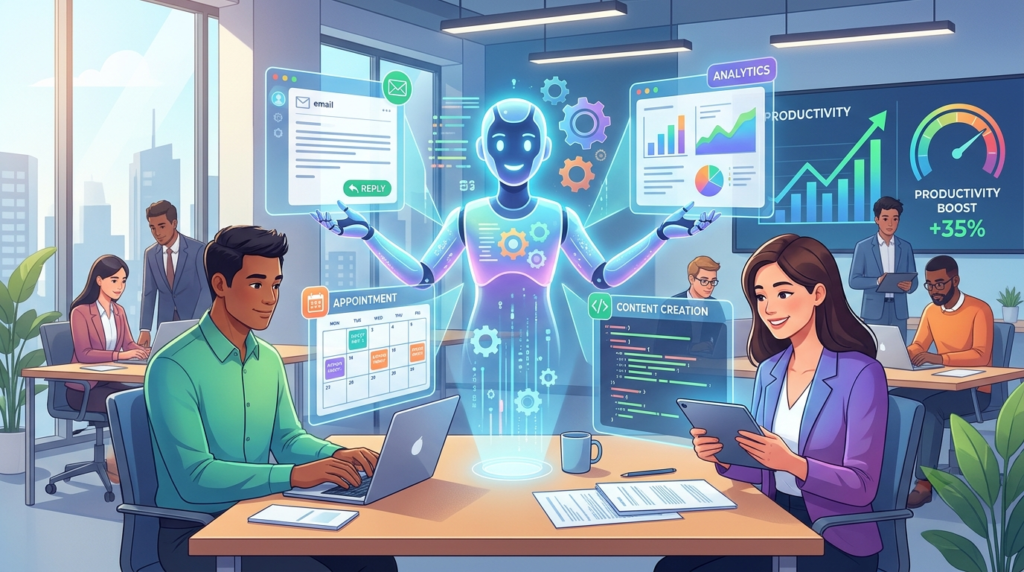
Running a business involves more than making important decisions. Every day, teams spend hours replying to emails, preparing reports, creating marketing content, organising information, and managing customer enquiries. While these tasks are necessary, they can take time away from activities that help a business grow.
This is where Generative Artificial Intelligence (AI) can make a difference. From drafting emails to analysing business data, AI tools can help professionals complete everyday tasks more efficiently and focus on higher-value work.
Today, generative AI for business is becoming an important part of digital transformation. Entrepreneurs, managers, and professionals can use AI to simplify workflows, improve productivity, and explore new ways of working.
In this blog, we will explore how businesses can use AI for everyday tasks, the tools worth considering, and how professionals can develop the skills needed to use these technologies effectively.
What Is Generative AI and How Does It Help Businesses?
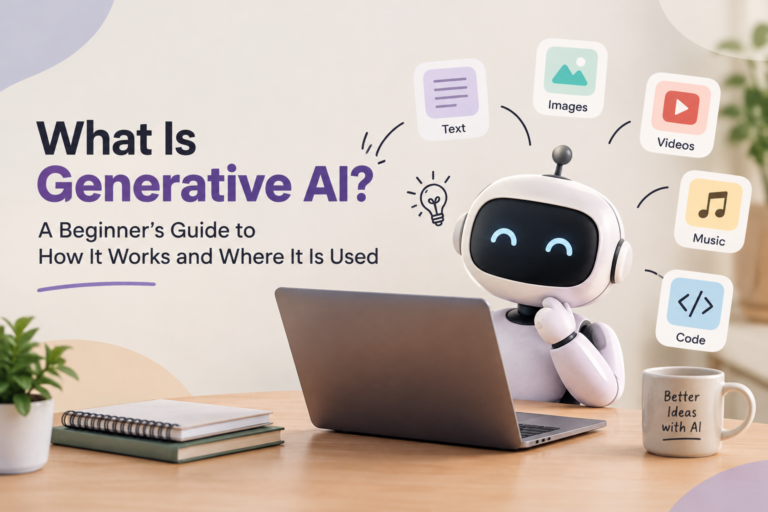
Generative AI is a type of artificial intelligence that can create new content, including text, images, summaries, presentations, and computer code, based on user instructions. Unlike traditional automation, which usually follows predefined rules, Generative AI can interpret instructions and help produce different outputs depending on the task.
For example, a business owner can use AI to draft a client email, a marketing manager can generate campaign ideas, and an HR professional can prepare an initial job description. When used thoughtfully, AI can reduce repetitive work, support creativity, and help teams organise information more efficiently. However, human review remains essential to ensure accuracy, quality, and appropriate decision-making.
7 Ways Businesses Can Use Generative AI to Automate Everyday Tasks
1. Automate Emails and Routine Communication
Writing emails, responding to enquiries, and preparing follow-ups can consume a significant amount of time. AI tools such as ChatGPT and Google Gemini can help draft professional emails, summarise long conversations, and adjust messages for different audiences.
For example, a sales manager can use AI to draft a follow-up email after a client meeting. The manager can then review the message, add relevant details, and send a personalised response. This makes communication more efficient without losing the human touch.
2. Create Marketing Content Faster
Businesses need regular content to remain visible online. Blog articles, social media posts, email newsletters, and advertisements all require planning and creativity. Generative AI can help teams brainstorm topics, prepare content outlines, suggest headlines, and develop initial drafts.
A small business, for instance, could use AI to turn one product announcement into several social media post ideas. A marketer could then adapt each post for Instagram, LinkedIn, or Facebook. Combining AI with a clear content strategy helps businesses maintain consistency while leaving room for human creativity and brand personality.
3. Improve Customer Support
Customers often ask similar questions about product features, pricing, delivery, bookings, and service availability. AI-powered chatbots can help answer common questions, guide customers towards relevant information, and direct complicated enquiries to the appropriate team member.
For example, an online store can use an appropriately configured chatbot to answer frequently asked questions outside regular business hours. However, businesses should establish clear escalation processes for complaints, sensitive information, and situations that require human judgement. AI responses should also be checked for accuracy.
4. Simplify Research and Report Preparation
Preparing reports often involves collecting information from multiple sources, organising data, and summarising findings. AI tools can help summarise documents, organise research notes, identify patterns in suitable datasets, and prepare first drafts of reports.
A marketing manager could use AI to organise campaign observations into a structured report before reviewing the actual performance figures. This is a useful example of AI business automation, where technology assists with time-consuming steps while employees remain responsible for verifying information and making decisions.
5. Support Sales and Lead Management
Sales teams frequently handle lead lists, meeting notes, customer questions, and follow-up schedules. AI can help summarise sales conversations, draft personalised outreach messages, classify enquiries, and prepare follow-up reminders when connected to suitable business systems.
For instance, a sales representative could use AI to turn meeting notes into a list of client requirements and proposed next steps. Businesses should use approved tools, protect customer information, and avoid relying on AI alone to make important decisions about customers.
6. Streamline Meetings and Internal Documentation
Meetings are useful, but preparing agendas, recording decisions, and sharing action points can take additional time. AI-assisted meeting tools can help generate summaries, extract action items, and organise notes, depending on the platform and its permissions.
Managers can also use AI to create standard operating procedure drafts, onboarding documents, training materials, and internal knowledge resources. Before sharing these documents, employees should verify important details and ensure confidential discussions are handled appropriately.
7. Generate Ideas for Design and Business Planning
AI is not limited to writing and administration. It can also support brainstorming, visual concept development, and early-stage business planning. Tools such as Canva AI and Adobe Firefly can assist with creative concepts and visual assets. ChatGPT can help organise a business proposal or explore possible campaign approaches.
For example, a small business could develop several promotional concepts before selecting one that matches its brand identity and target audience. AI provides a starting point, but originality, design quality, and business relevance still depend on human input.
Best AI Productivity Tools Businesses Can Explore
Choosing the right tools depends on the tasks a business wants to improve, its budget, and its existing software.
Here are some options worth exploring:
- ChatGPT: Drafting, brainstorming, summarising information, and planning.
- Google Gemini: Writing assistance, research support, and productivity tasks.
- Microsoft Copilot: Assistance with supported Microsoft 365 workflows, depending on the plan and configuration.
- Canva AI: Developing visual concepts, presentations, and marketing creatives.
- Zapier: Connecting compatible applications to automate repetitive workflows.
- Notion AI: Supporting documentation, note organisation, and knowledge management within supported workflows.
These AI productivity tools serve different purposes. Some generate content, while others help connect applications or organise information. Businesses should compare features, costs, privacy settings, and integrations before choosing a solution.
How to Implement AI Business Automation Successfully
Adopting AI does not mean automating every process immediately. A gradual approach can help businesses understand what works before investing in more advanced systems.
Step 1: Identify Repetitive Tasks
Start by listing activities that consume time but follow a reasonably consistent process, such as preparing email drafts, summarising reports, or organising content ideas.
Step 2: Choose the Right Tool
Select a tool based on the specific problem you want to solve. Avoid paying for multiple platforms that perform similar functions without a clear business need.
Step 3: Start with a Small Pilot Project
Test AI on one workflow before introducing it across the organisation. For example, use it to prepare first drafts of weekly reports and compare the time required with your existing process.
Step 4: Measure Productivity Improvements
Track indicators such as time saved, task completion rates, error rates, content quality, and customer satisfaction. Productivity improvements should be measured rather than assumed.
Step 5: Train Employees and Set Guidelines
Employees need to understand how to write effective prompts, verify AI outputs, protect confidential information, and recognise the limitations of AI-generated content. Human review, appropriate access controls, and clear usage policies should be part of every implementation plan.
Challenges Businesses Should Consider Before Using AI
Although AI offers many benefits, it is not a complete replacement for human expertise. AI-generated information can be inaccurate, outdated, biased, or inconsistent with a company’s requirements. Businesses should verify important claims, review customer-facing content, and avoid entering sensitive data into unapproved tools.
There may also be costs associated with subscriptions, integrations, training, and maintaining automated workflows. The best approach is to use AI where it provides measurable value while keeping people involved in decisions that require judgement, accountability, and personal understanding.
Why AI Skills Matter for Today’s Professionals
As businesses adopt new technologies, employees increasingly need a combination of digital knowledge, communication skills, critical thinking, and practical AI experience. Learning how to use AI for marketing, content creation, reporting, and workflow improvement can help professionals contribute more effectively to their organisations.
At IIEDM, professionals and aspiring digital marketers can explore industry-oriented digital marketing education, practical learning, and AI-related applications in marketing. IIEDM also offers corporate training workshops designed to help teams strengthen their digital marketing capabilities through hands-on learning and relevant case studies.
Businesses interested in upskilling their teams can explore IIEDM’s Corporate Training Program to learn more about its training offerings.
Final Thoughts
Generative AI is changing how businesses approach everyday work. From email drafting and content creation to customer support and report preparation, it can help teams reduce repetitive effort and improve productivity when implemented thoughtfully.
The key is to start small, select the right tools, train employees, and measure the results. Businesses that combine AI capabilities with human creativity, critical thinking, and responsible decision-making will be better equipped to adapt to changing workplace demands.
Ready to build your AI and digital skills? Visit IIEDM to explore digital marketing programmes and training opportunities that can help you prepare for an increasingly technology-driven business environment.