Artificial Intelligence is changing the way people learn, work and manage everyday business activities. From creating content and analysing data to automating tasks and improving customer experiences, AI-powered technologies are becoming increasingly important across industries.
Bengaluru, known for its technology companies, startups and growing business ecosystem, is an exciting place for people looking to develop skills in emerging technologies. Students, fresh graduates and working professionals are exploring AI to improve their knowledge, stay relevant in their industries and prepare for new career opportunities.
But with so many tools and training programmes available, choosing the right AI course can be confusing. What should you learn as a beginner? Do you need coding knowledge? And how can AI skills help you professionally?
This guide will help you understand what to look for when exploring AI courses in Bengaluru.
Why Is Learning Artificial Intelligence Important in 2027?
Artificial Intelligence is no longer limited to software developers or technology companies. Businesses across marketing, education, finance, retail, healthcare and other industries are exploring AI to improve productivity and simplify their operations.
For example, marketing teams use AI tools to research topics, create content and analyse campaign performance. Businesses use AI-powered chatbots to respond to customer enquiries, while professionals use AI assistants to organise information and complete repetitive tasks.
For students, learning AI can provide exposure to technologies that are becoming increasingly relevant in the workplace. Working professionals can use these skills to improve their existing workflows or explore different career opportunities.
The goal is not simply to learn how to operate AI tools. It is to understand how these technologies can be applied to solve real-world problems.
What Should You Learn in an AI Course?
If you are a beginner exploring Artificial Intelligence courses in Bengaluru, look for a programme that introduces essential concepts and gives you opportunities to apply them.
Here are some important areas worth exploring.
1. Artificial Intelligence Fundamentals
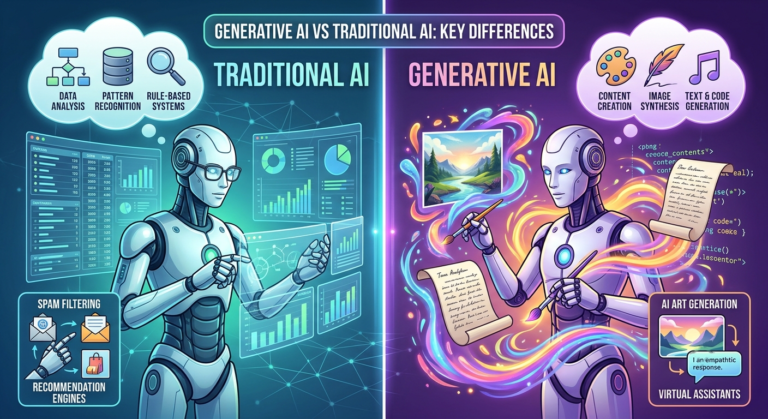
Start by understanding what AI is, how it works and where it is used. Learn the basic differences between Artificial Intelligence, Machine Learning and Generative AI.
Having a strong foundation makes it easier to understand new technologies and their practical applications.
2. Generative AI and Prompt Engineering
Generative AI tools can create text, images, presentations and other forms of digital content.
Prompt engineering involves providing clear instructions to AI tools to get relevant results. For example, you can ask an AI assistant to prepare a social media content calendar by specifying the business, target audience, platform and communication style.
Learning how to write effective prompts, refine responses and check the accuracy of generated information is useful for both students and professionals.
3. AI Tools for Content Creation
AI-powered platforms such as ChatGPT and Google Gemini can support research, brainstorming, writing and content planning.
Creative professionals can also explore AI-assisted image and design tools to develop visual concepts and marketing materials.
However, AI-generated content still requires human review. Creativity, originality, accuracy and an understanding of the target audience remain important.
4. AI for Digital Marketing and SEO
Digital marketing is one of the areas where AI has several practical applications.
AI tools can assist with keyword research, blog planning, social media content, audience analysis and advertising ideas. They can also help marketers organise information and understand campaign performance.
Along with AI, learners should understand digital marketing fundamentals such as Search Engine Optimisation (SEO), Social Media Marketing (SMM), Search Engine Marketing (SEM) and performance analytics.
Combining marketing knowledge with AI applications can help learners understand how businesses use technology to reach customers and achieve marketing goals.
5. AI Automation and Data Analysis
Businesses often perform repetitive tasks such as organising customer information, sending follow-up emails and preparing reports.
AI-powered automation can help simplify some of these activities. Beginners can explore chatbots, automated workflows and no-code automation platforms.
It is also useful to understand basic data analysis, spreadsheets and reporting. These skills can help professionals interpret information and make better business decisions.
AI Skills for Students: How Can They Prepare for the Future?
For college students and fresh graduates, learning AI can be a useful way to complement their academic qualifications.
Instead of focusing only on theoretical knowledge, students should experiment with beginner-friendly tools and work on practical assignments.
For example, a student interested in marketing could create a sample digital campaign using AI for content ideas and keyword research. Someone interested in design could develop a small portfolio of AI-assisted creative concepts.
Other useful steps include:
Learning the basics of AI and Generative AI.
Practising prompt engineering.
Exploring AI applications in a chosen industry.
Completing practical projects and assignments.
Building a portfolio to demonstrate skills.
Improving communication, creativity and problem-solving abilities.
These activities can help students understand how AI is used professionally and prepare for internships or entry-level opportunities.
How Can Working Professionals Benefit from AI Training?
AI is not just for students. Working professionals can also benefit from learning how to use these technologies in their existing roles.
A marketing executive can use AI to support content planning and campaign research. An entrepreneur can explore automation to simplify business activities, while an administrative professional can use AI assistants to organise information and improve productivity.
Professionals from sales, marketing, management, design and other fields can explore AI applications relevant to their responsibilities.
Before enrolling in an AI training programme, identify what you want to achieve. Whether it is improving productivity, upgrading your existing skills or exploring a career change, having a clear learning objective will help you choose the right course.
Career Opportunities After Learning AI Skills
AI knowledge can complement several professional roles. Depending on your interests, educational background and additional skills, you can explore opportunities such as:
AI-assisted Content Creator
Digital Marketing Executive
SEO Executive
Social Media Marketing Executive
Performance Marketing Executive
Marketing Analyst
Marketing Automation Executive
AI-assisted Creative Designer
Remember that completing an AI course does not automatically guarantee employment. Practical experience, communication skills, industry knowledge and problem-solving abilities are equally important when preparing for a professional role.
How to Choose the Right AI Course in Bengaluru?
With several training options available, selecting the right institute requires careful consideration.
Before enrolling, check these important factors:
Beginner-friendly curriculum: The programme should explain AI concepts from the basics.
Practical training: Look for hands-on assignments, projects and opportunities to use relevant tools.
Industry relevance: Check whether the curriculum reflects current business and technology applications.
Experienced trainers: Industry exposure can help you understand how AI is used in professional environments.
Flexible learning options: Students and working professionals should consider online or classroom formats and batch schedules.
Career support: Resume guidance, mock interviews and placement assistance can help learners prepare for recruitment.
A good course should help you understand not just which AI tools are available, but also how to apply them effectively.
Explore AI-Driven Digital Marketing Education at IIEDM Bengaluru
If you are looking for industry-focused training in Bengaluru, IIEDM Institute offers digital marketing programmes that introduce learners to modern marketing practices and emerging technologies.
The institute provides an Advanced Certificate Course in Digital Marketing with 3-month and 5-month options, available through online and offline learning. It also offers a one-year MBA-level Post Graduate Programme in Digital Marketing.
IIEDM focuses on an industry-designed curriculum, practical training, live projects and real-world case studies. Students can also explore career preparation support, including resume guidance, mock interviews and placement assistance.
For learners interested in understanding how AI supports modern marketing, combining AI applications with knowledge of SEO, social media marketing, paid advertising, content creation and analytics can be a valuable learning approach.
IIEDM’s Bengaluru centre is located in Jayanagar, making it an option for students and working professionals looking for classroom-based digital marketing education.
IIEDM Bengaluru Centre:
136/19, 6th C Main Road, 4th Block, Jayanagar, Bengaluru, Karnataka 560011
Visit the official IIEDM website to explore the available programmes, current curriculum and batch options.
Final Thoughts
Artificial Intelligence is creating new ways for people to learn, work and approach everyday business challenges. For students, it offers an opportunity to develop future-ready skills. For working professionals, it can help improve productivity and strengthen existing expertise.
When exploring AI courses in Bengaluru, focus on the quality of the curriculum, practical exposure, industry relevance and learning support.
You do not need to master every AI tool at once. Start with the fundamentals, practise regularly and understand how AI connects with your chosen field.
Ultimately, the most valuable professionals will be those who can combine technology with creativity, critical thinking and practical knowledge. Learning AI today can be a meaningful step towards preparing for tomorrow’s opportunities.