Artificial Intelligence (AI) is becoming a part of our everyday lives, from the recommendations we see online to the chatbots that answer our questions. But not all AI works in the same way. Some AI systems analyse information and predict outcomes, while others create entirely new content, such as text, images, videos, and music.
This is where the difference between Generative AI and traditional AI becomes important.
If you are a student, working professional, entrepreneur, or someone exploring AI for the first time, understanding these technologies can help you identify how they are used in different industries. In this blog, we will explain Generative AI vs AI, explore the main differences, share practical examples, and discuss how these technologies are transforming digital marketing and business.
What Is Traditional AI?
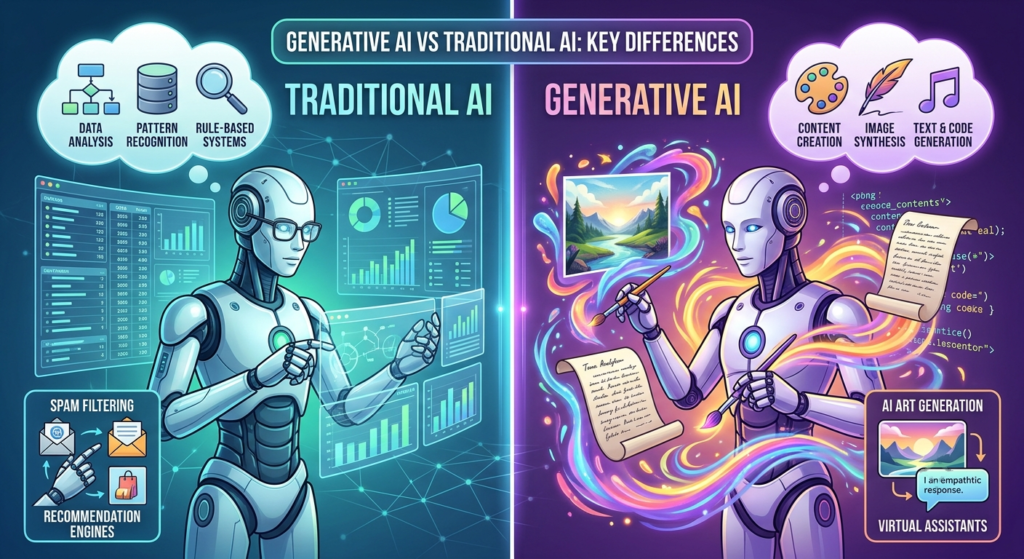
Traditional AI refers to AI systems designed to perform specific tasks, such as classifying information, identifying patterns, making predictions, or recommending products based on existing data. These systems typically work towards a defined objective. They learn patterns from data or follow programmed rules to produce a result.
For example, an email service may use AI to identify spam messages, while an e-commerce website may recommend products based on your browsing and purchase history.
Traditional AI is particularly useful when a business needs to analyse information, recognise patterns, or predict likely outcomes.
Examples of Traditional AI
- Spam detection: Identifies emails that are likely to be unwanted or fraudulent.
- Product recommendations: Suggests products based on customer behaviour.
- Sales forecasting: Estimates future sales using historical data.
- Fraud detection: Flags unusual transaction patterns for further review.
- Customer segmentation: Groups customers according to shared characteristics or behaviour.
These applications help businesses make informed decisions and manage large amounts of data efficiently.
What Is Generative AI?
Generative AI is a type of artificial intelligence that can create new content based on instructions, prompts, or other inputs. Instead of only classifying information or predicting a particular outcome, Generative AI can produce text, images, audio, video, and computer code by learning patterns from training data.
For example, you can ask ChatGPT to draft a blog introduction, use an AI image generator to create a visual concept, or ask an AI assistant to summarise a lengthy document. Generative AI is particularly useful for tasks that involve content creation, brainstorming, communication, and working with information in natural language.
Here are some common examples of Generative AI in action:
- Content writing: Generating blog outlines, email drafts, and social media captions.
- Image generation: Creating visual concepts from text descriptions.
- Video creation: Assisting with scripts, storyboards, and AI-generated video content.
- Code generation: Helping developers write, explain, and improve code.
- Document summarisation: Turning lengthy documents into shorter, easier-to-understand summaries.
- Conversational assistants: Answering questions and helping users complete tasks through natural-language conversations.
Tools such as ChatGPT, Google Gemini, and Adobe Firefly offer different Generative AI capabilities.
Generative AI vs AI: What Is the Main Difference?
One important clarification is that Generative AI is a type of AI. Therefore, comparing Generative AI with traditional AI is more precise than treating Generative AI and AI as two completely separate technologies.
The main difference lies in what they are designed to do.
Traditional AI often focuses on analysing existing information, identifying patterns, classifying data, or predicting outcomes. Generative AI focuses on producing new content based on patterns learned during training.
Key Differences Between Traditional AI and Generative AI
Traditional AI and Generative AI are transforming how businesses analyse information, make decisions, and create content. However, they differ in their purposes, capabilities, and applications.
1. Main Purpose: Traditional AI focuses on analysing data, identifying patterns, and making predictions. In contrast, Generative AI creates new content based on the information it learns and the prompts it receives.
2. Typical Output: Traditional AI produces scores, categories, predictions, and recommendations. Generative AI generates content such as text, images, audio, video, and code.
3. Common Input: Traditional AI typically works with historical data, structured information, or specific signals to perform analysis. Generative AI can process prompts, text, images, audio, and other supported inputs to generate relevant content.
4. Example: Traditional AI can predict next month’s sales by analysing historical sales data. Generative AI can use a prompt to draft a sales presentation, complete with key points and recommendations.
5. Business Use: Traditional AI is commonly used for fraud detection, demand forecasting, and identifying customer behaviour patterns. Generative AI supports content creation, marketing campaigns, and document summarisation.
6. Human Involvement: Traditional AI often requires humans to review predictions and make informed decisions. Generative AI requires humans to review, verify, and refine generated content to ensure accuracy and relevance.
How Do Traditional AI and Generative AI Work Together?
Businesses do not always need to choose one technology over the other. In many situations, combining both approaches can provide more value.
Imagine an online store that wants to improve its marketing campaigns.First, a traditional predictive AI system analyses customer behaviour and identifies groups of customers who may be interested in different products. Next, a Generative AI tool helps create personalised email drafts for those groups.
The predictive system helps identify the audience, while Generative AI helps prepare the communication.Similarly, a business could use traditional AI to forecast demand and Generative AI to summarise the forecast in a report for managers.
This combination allows businesses to use data-driven insights alongside AI-assisted communication and content creation.
Applications of AI in Digital Marketing
Digital marketing is one area where both traditional AI and Generative AI can support everyday work.
1. Search Engine Optimisation (SEO)
Traditional AI techniques can help identify patterns in search behaviour and support ranking or classification tasks. Generative AI can assist with brainstorming keywords, creating blog outlines, and drafting meta descriptions. Marketers still need to understand search intent, verify facts, and ensure that content is genuinely useful to readers.
2. Social Media Marketing
Generative AI can suggest captions, post ideas, content calendars, and creative concepts. Traditional AI-powered analytics can help identify engagement patterns and understand which content performs well. Together, these capabilities can help social media teams plan content more efficiently and make better-informed decisions.
3. Paid Advertising
AI-powered advertising platforms can use predictive models and optimisation systems to support bidding, audience selection, and campaign delivery. Generative AI can help marketers brainstorm advertising messages, headlines, and creative variations. Human review remains important to ensure that advertising content is accurate, relevant, and consistent with brand guidelines.
4. Customer Experience and Personalisation
Traditional recommendation systems can suggest products based on customer preferences. Generative AI can support conversational chatbots that answer questions, explain product features, and help customers find information. Businesses should provide appropriate safeguards and ensure customers can reach a human representative when needed.
Which Types of Artificial Intelligence Should Beginners Know?
When exploring the types of artificial intelligence, it helps to understand that AI can be classified in different ways.
One common approach is to distinguish AI by capability, such as narrow AI, general AI, and the theoretical concept of superintelligent AI. Another approach is to group systems by their methods and applications, such as machine learning, predictive AI, computer vision, and Generative AI.
For beginners, the following concepts are useful starting points:
- Machine learning: Enables systems to learn patterns from data.
- Predictive AI: Uses data and patterns to estimate likely future outcomes.
- Natural language processing: Helps computers process and work with human language.
- Computer vision: Enables systems to interpret images and videos.
- Generative AI: Produces new content, such as text, images, and audio.
These categories can overlap. For example, Generative AI often uses machine learning and may include natural language processing or computer vision capabilities.
Which Is Better: Traditional AI or Generative AI?
Neither technology is universally better. The right choice depends on the problem you want to solve. Choose traditional or predictive AI when you need to classify data, detect unusual patterns, forecast sales, or estimate customer behaviour. Choose Generative AI when you need to create content, summarise information, brainstorm ideas, or interact with information through natural-language prompts. Consider combining both when your workflow requires data analysis as well as content creation.
For example, a digital marketing team could use predictive analytics to understand campaign performance and Generative AI to prepare a summary of the results. Employees can then review the findings and decide what changes to make.
Learn AI and Digital Marketing Skills with IIEDM
Understanding AI is becoming increasingly valuable for students, entrepreneurs, and professionals who want to develop relevant digital skills.
IIEDM offers AI and digital marketing programmes that combine industry-oriented learning with practical applications. Its training offerings cover areas such as SEO, social media marketing, paid advertising, and AI-related applications in digital marketing.
Learning these subjects together can help students understand not only how AI tools work, but also how to apply them to real marketing activities. If you want to build your knowledge of AI and explore a career in digital marketing, visit IIEDM Institute to review the available courses and programme details.
Conclusion
The difference between traditional AI and Generative AI comes down to their primary purpose. Traditional AI is commonly used to analyse information, recognise patterns, classify data, and make predictions. Generative AI focuses on creating new content, including text, images, videos, and code.
Both technologies have practical applications across industries, and they can work together to improve productivity, support decision-making, and enhance customer experiences.
For beginners, the best way to understand AI is to explore real examples, experiment with accessible tools, and learn how to apply each approach to a specific problem. With the right knowledge and practical experience, you can build a stronger foundation for working in an increasingly AI-driven world.