Artificial Intelligence (AI) is changing how people work, learn, and create content. From writing social media captions to generating blog ideas and analysing information, AI tools are becoming useful for students, professionals, and businesses. However, the quality of the results often depends on one important factor: how you ask the AI to perform a task.
This is where prompt engineering comes in.
Whether you are a student exploring AI, a digital marketer creating content, or a professional looking to improve productivity, understanding how to communicate with AI tools can help you get more relevant and useful results. The good news is that you do not need advanced coding knowledge to start. With a few practical techniques and regular practice, anyone can learn the basics.
In this blog, we will explain what prompt engineering is, why it matters, and which AI prompting techniques you can use to improve your results.
What Is Prompt Engineering?
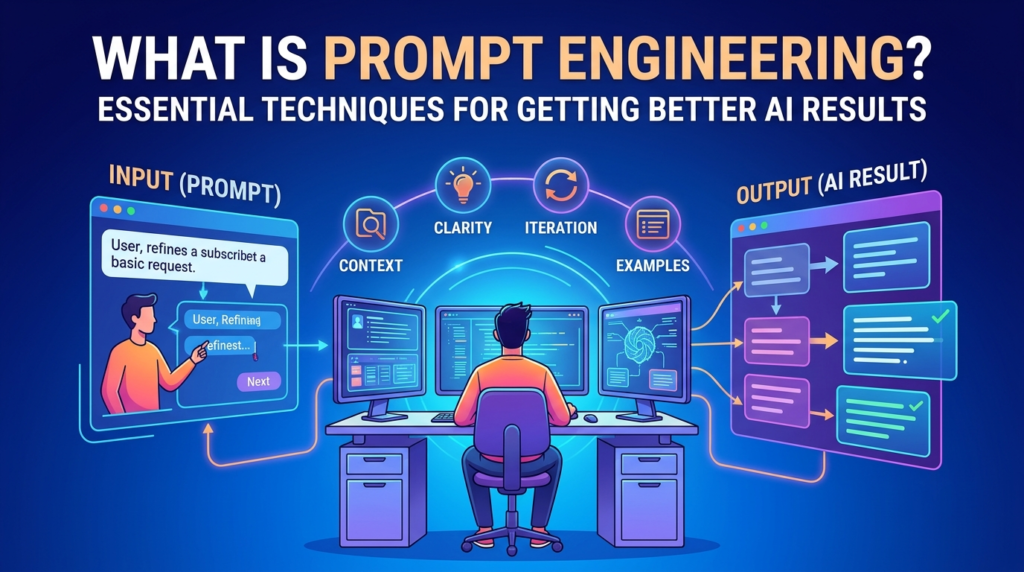
Prompt engineering is the process of designing and improving instructions given to an AI tool to achieve a specific outcome.A prompt can be a question, a command, or a detailed set of instructions. The clearer your prompt, the easier it is for an AI tool to understand what you need.For example, if you ask an AI tool to “write a blog,” the response may be too general. But if you specify the topic, target audience, word count, tone, and keywords, the result is more likely to match your requirements.Prompt engineering is not just about writing longer instructions. It is about providing the right context, explaining your objective, and refining the response when necessary.
Why Is Prompt Engineering Important in 2026?
AI tools are being used across content creation, digital marketing, customer service, research, education, and business operations. Learning to communicate effectively with these tools can make everyday tasks easier.
Here are some key benefits of prompt engineering:
- Saves time: Generate useful first drafts, summaries, and ideas more efficiently.
- Improves content quality: Guide AI towards a specific tone, format, and audience.
- Supports creativity: Explore different concepts for campaigns, blogs, and designs.
- Improves productivity: Simplify repetitive tasks and organise information.
- Helps with problem-solving: Break complex tasks into smaller, manageable steps.
However, even a well-written prompt cannot guarantee a completely accurate answer. AI-generated information should still be checked, especially when it involves facts, statistics, business decisions, or current information.
6 Essential AI Prompting Techniques for Better Results
Learning a few simple techniques can improve how you use AI tools in your daily work.
1. Be Clear and Specific
One of the most common mistakes beginners make is giving vague instructions. AI tools work better when you clearly explain what you want them to do.
Vague prompt: “Write something about digital marketing.”
Improved prompt: “Write a 500-word beginner-friendly blog explaining the importance of digital marketing for small businesses. Use simple English, clear headings, and practical examples.”
The second prompt provides a clear topic, length, audience, and format. This reduces ambiguity and gives the AI a better starting point.
2. Provide Context
Context helps the AI understand the situation in which the response will be used.
For example, writing an Instagram caption for a fashion brand requires a different approach from writing a LinkedIn post for a corporate training institute.
Try including details such as:
- Your industry or business type.
- Your target audience.
- Your objective.
- Your brand voice.
The platform where the content will appear. The more relevant context you provide, the easier it becomes to generate an appropriate response.
3. Assign a Role to the AI
You can ask an AI tool to approach a task from a particular professional perspective.
For example: “Act as an SEO content strategist. Suggest 10 blog topics for a digital marketing institute targeting college students in Mumbai. Focus on search intent and beginner-friendly topics.”
This instruction helps establish the perspective and expertise you want reflected in the response. However, assigning a role does not guarantee expert-level accuracy, so review the suggestions before using them.
4. Specify the Output Format
Sometimes the information is correct, but the format is not useful. You can avoid this by telling the AI exactly how you want the response organised.
For example, ask for:
- A step-by-step guide.
- A comparison table.
- A list of ideas with explanations.
- A professional email.
- A blog with H2 and H3 headings.
- A social media content calendar.
For digital marketers, this technique is particularly helpful when preparing campaign plans, keyword lists, content calendars, and performance summaries.
5. Use Examples to Guide the Response
If you have a preferred writing style or format, provide an example. This approach helps the AI understand your expectations more clearly.
For instance, you can share a sample social media caption and ask the tool to create five new captions with a similar tone while using different ideas.
Examples are especially useful for maintaining consistency across brand communications. Make sure you have permission to use any reference material and avoid copying another brand’s distinctive content.
6. Refine the Prompt Through Follow-Up Instructions
Your first response does not have to be the final one. Prompt engineering often involves reviewing the result and giving additional instructions.
You might say:
- “Make the introduction more engaging.”
- “Use simpler language for beginners.”
- “Remove repetitive points.”
- “Add practical examples from digital marketing.”
- “Make the tone more natural and less formal.”
Treat AI as a collaborative tool. Review what it produces, identify what is missing, and refine your instructions until the output meets your needs.
A Simple Prompt Formula Beginners Can Use
If you are new to AI, use this simple structure to create better prompts: Role + Task + Context + Requirements + Output Format
For example: “You are a digital marketing content writer. Create five Instagram caption ideas for a digital marketing institute in Mumbai. The audience is college students interested in building a marketing career. Use a friendly, relatable tone, include a clear call to action, and present each caption as a separate numbered item.”
You can adapt this formula for blog writing, research, email drafting, brainstorming, and many other tasks. Not every prompt needs all five elements, but the structure provides a helpful starting point.
How Digital Marketers Can Use Prompt Engineering
Prompt engineering has practical applications in digital marketing because marketers regularly work with content, research, advertising, and customer communication.
Here are a few examples:
- SEO and blogging: Generate topic ideas, prepare blog outlines, create title variations, and develop meta description drafts.
- Social media marketing: Brainstorm post ideas, write captions, adapt content for different platforms, and plan monthly content calendars.
- Google Ads and paid campaigns: Develop headline variations, brainstorm calls to action, and explore different messaging angles for a target audience.
- Email marketing: Draft newsletters, personalise messaging for different audience segments, and improve subject line ideas.
- Content strategy: Organise audience questions, brainstorm campaign themes, and turn research notes into structured content plans.
At every stage, human judgement remains important. Marketers must verify facts, understand search intent, follow platform policies, and ensure that the final content reflects the brand’s objectives.
How to Learn Prompt Engineering as a Beginner
You can start learning prompt engineering without a technical background. Follow these practical steps:
- Choose an AI tool: Begin with a tool such as ChatGPT or Google Gemini.
- Practise everyday tasks: Ask the tool to summarise an article, draft an email, or suggest content ideas.
- Experiment with prompts: Change the context, tone, format, and level of detail to compare the results.
- Check the output: Look for factual errors, irrelevant information, repetition, and missing details.
- Build small projects: Create a sample blog, social media calendar, or marketing campaign using AI assistance.
- Keep learning: Explore more advanced prompting methods as your confidence grows.
If you prefer guided learning, look for a prompt engineering course or an AI-focused training programme that includes practical assignments, real-world use cases, and feedback. Before enrolling, check the curriculum and confirm that it covers the tools and applications relevant to your goals.
Learn AI and Digital Marketing Skills with IIEDM
As AI becomes more common in the workplace, professionals need to understand not only how to use AI tools but also how to apply them to real tasks.
IIEDM offers AI-driven digital marketing programmes with a focus on practical learning and industry-relevant applications. Its website also features content covering AI in digital marketing, content creation, and prompt engineering for marketing.
For students, aspiring marketers, and working professionals, combining AI prompting techniques with SEO, social media marketing, paid advertising, and content strategy can provide a useful foundation for working in the digital industry.
Explore the programmes available at IIEDM Institute to find a learning path that aligns with your career goals.
Conclusion
Prompt engineering is a practical skill that helps you get more relevant results from AI tools. By writing clear instructions, providing context, specifying the output format, using examples, and refining your prompts, you can improve the way you work with AI.
You do not need to learn every technique at once. Start with simple tasks, experiment regularly, and evaluate the results critically.
The key to better AI results is not just using the right tool, but knowing how to guide it effectively. With consistent practice and the right digital skills, prompt engineering can become a valuable part of your personal and professional development.