From students exploring new career paths to professionals looking to upgrade their skills, more people are interested in learning how to use AI effectively.
However, with so many online programmes, workshops, and training options available, choosing the right Generative AI course can feel confusing. Some courses focus mainly on theory, while others emphasise practical applications and real-world projects.
So, how do you decide which course is right for you?
The answer depends on your career goals, current skill level, learning preferences, and the kind of experience you want to gain. In this guide, we will explain what to look for in a Generative AI course and how to identify a programme that offers practical value.
Why Should You Consider Learning Generative AI?
Generative AI tools can create text, images, videos, code, and other types of content from user instructions. Businesses are exploring these tools to support content creation, research, customer communication, workflow automation, and productivity.
Learning AI can help you understand how to apply these capabilities to real tasks rather than simply experimenting with different tools.
For example, a digital marketer might use AI to brainstorm campaign ideas, while a designer could explore AI-assisted visual concepts. A business professional might use AI to summarise documents or organise information.
The right training can help you understand both the possibilities and the limitations of AI, including the importance of fact-checking, data privacy, and human judgement.
1. Check the Course Curriculum Before Enrolling
The curriculum is one of the most important factors when comparing Generative AI courses. A good programme should match your learning goals and provide a clear progression from basic concepts to practical applications.
Before enrolling, check whether the curriculum covers the following topics.
Generative AI Fundamentals
Beginners should understand what Generative AI is, how it works at a high level, and how it differs from other AI applications. You should also learn about common limitations, including inaccurate outputs and potential bias.
Prompt Engineering
Prompt engineering involves writing clear instructions to guide AI tools towards useful results. Look for lessons on providing context, defining objectives, specifying output formats, and refining prompts.
AI Tools and Applications
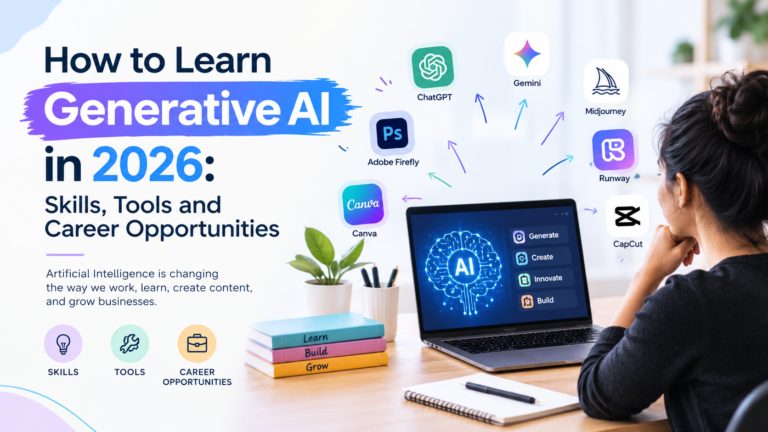
The tools covered should match your goals. Depending on the programme, these might include ChatGPT, Google Gemini, Canva AI, or other platforms used for writing, research, design, and productivity.
Automation and Workflow Improvement
If your goal is to improve workplace productivity, look for practical examples of how AI can assist with repetitive tasks and connect with other tools. Advanced automation training may also cover APIs or workflow platforms.
Responsible AI Usage
A well-rounded curriculum should explain how to verify outputs, protect sensitive information, consider copyright, and use AI responsibly.
Tip: Ask for the detailed syllabus before paying for a course. A list of tool names alone does not explain what you will actually learn to do with them.
2. Prioritise Practical AI Training Over Theory Alone
Understanding AI concepts is important, but applying them to real situations helps you develop confidence.
When comparing programmes, look for practical AI training that includes guided exercises, assignments, case studies, and projects.
For example, a student interested in digital marketing could create an AI-assisted content calendar, develop advertising concepts, or prepare an SEO blog outline. Someone interested in business productivity could design a workflow for summarising documents or drafting routine communications.
Practical assignments help you understand where AI saves time, where it makes mistakes, and how human input improves the final result.
Before enrolling, ask how much of the programme involves hands-on work and whether you will receive feedback on your assignments.
3. Look for Real-World Projects and Portfolio Development
Projects are valuable because they demonstrate how you apply what you have learned.
A course that includes meaningful projects can help you build a portfolio that showcases your process, problem-solving abilities, and practical skills.
Depending on your interests, useful projects might include:
- An AI-assisted social media content strategy.
- A chatbot prototype for frequently asked questions.
- A set of AI-generated advertising concepts.
- An SEO-friendly blog supported by keyword research.
- An AI-assisted business reporting workflow.
- A visual branding project using AI design tools.
A good project should go beyond generating an output. You should be able to explain the problem, the tools used, the decisions you made, and how you checked the final result.
If a course advertises live projects, ask whether these involve actual business requirements, guided simulations, or independent practice exercises.
4. Evaluate the Trainers’ Industry Experience
AI tools are evolving, so learning from instructors who understand practical applications can be beneficial.
Review the trainers’ professional backgrounds, industry experience, teaching approach, and familiarity with the tools covered in the curriculum.
You should also check whether the programme offers opportunities to ask questions, receive feedback, and understand how AI is used in real workplace situations.
An experienced trainer should help you understand not only how to use a tool, but also when it is appropriate to use it and when human expertise is necessary.
5. Choose a Course That Matches Your Career Goals
Not every Generative AI course is designed for the same audience. Before selecting a programme, identify what you want to achieve.
For students and beginners: Start with AI fundamentals, prompt engineering, and accessible tools. Focus on building confidence through small projects.
For digital marketers: Look for AI applications in SEO, content creation, social media, advertising, and analytics.
For designers and creative professionals: Explore AI-assisted image generation, visual ideation, creative workflows, and design tools.
For business professionals: Prioritise document summarisation, research, productivity, workflow automation, and responsible AI use.
For aspiring AI developers: Look for technical programmes that include Python, machine learning fundamentals, APIs, model evaluation, and application development.
Choosing a course that matches your intended career path can help you avoid spending time on topics that are not relevant to your immediate goals.
6. Compare Course Fees, Duration and Learning Support
The best Generative AI course is not necessarily the most expensive one. Instead, compare what you receive for the price.
Consider the following factors:
- Course fees: Understand the total cost and any additional charges for tools, examinations, or learning materials.
- Duration: Check whether the schedule allows enough time to practise and complete projects.
- Learning format: Decide whether online, classroom-based, or live instructor-led learning suits you best.
- Support: Find out whether you can ask questions, receive assignment feedback, and revisit learning resources.
- Portfolio guidance: Check whether the course helps you document projects and present your work professionally.
- Career support: If relevant, ask about resume guidance, interview preparation, internships, and placement assistance.
Read reviews and ask specific questions before enrolling. Avoid choosing a course based only on promotional claims or promises of guaranteed career outcomes.
7. Understand How the Course Will Support Your Career
Completing a course can help you build knowledge, but employers also look for practical abilities, communication, problem-solving, and relevant experience.
Look for programmes that help you demonstrate your learning through completed projects and explain how those skills apply to workplace tasks.
If you are interested in AI-powered digital marketing, for example, learning prompt engineering alongside SEO, social media marketing, paid advertising, and content strategy can help you understand how AI fits into a wider marketing workflow.
For technical AI roles, you may need additional programming and machine learning knowledge beyond an introductory Generative AI course.
Explore AI and Digital Marketing Training at IIEDM
If you want to apply AI to marketing and creative work, IIEDM offers industry-oriented AI and digital marketing programmes with practical learning and project-based exposure.
Its website highlights hands-on training, live projects, expert-led learning, and career support. It also offers specialised programmes in areas such as UI/UX design and graphic design.
These options may be relevant if you want to develop AI-related capabilities alongside practical digital skills. Before enrolling, review the current curriculum and confirm which Generative AI topics, tools, and projects are included in the specific programme you are considering.
Visit IIEDM Institute to explore available courses, request programme details, and identify a learning path aligned with your goals.
Conclusion
Choosing the right Generative AI course starts with understanding what you want to learn and how you plan to use those skills.
Look for a relevant curriculum, practical assignments, meaningful projects, experienced trainers, and support that matches your learning needs. Compare course fees and duration carefully, and make sure the programme gives you opportunities to practise rather than simply watch demonstrations.
Most importantly, remember that learning AI is an ongoing process. The strongest foundation comes from combining structured training with experimentation, critical thinking, and real-world application.
Choose a course that helps you move from understanding AI to using it confidently and responsibly.