Introduction: The Growing Role of AI in Digital Marketing
Imagine creating a month’s worth of social media content, brainstorming advertising ideas, writing email campaigns, and analysing customer behaviour without starting everything from scratch. Sounds exciting, right? This is where generative AI is making a difference.
Digital marketing is constantly evolving, and artificial intelligence is changing how brands plan campaigns, communicate with audiences, and measure performance. From generating creative content to assisting with data analysis, AI is becoming an important part of modern marketing strategies.
But what does this mean for businesses, students, and aspiring marketers?
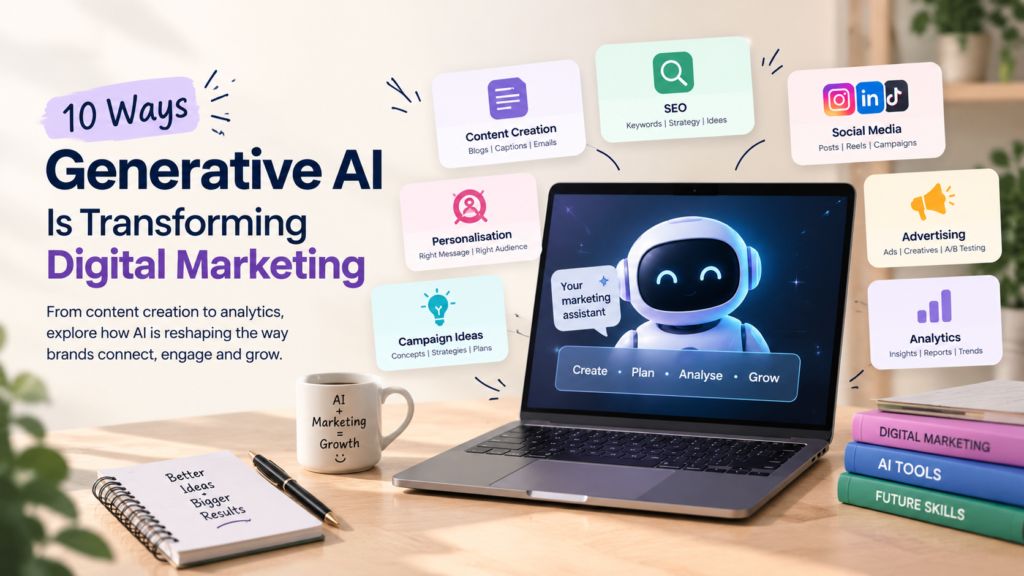
In this blog, we explore 10 ways generative AI in digital marketing is transforming the industry, the AI marketing tools worth exploring, and why learning these skills can help you prepare for the future of digital marketing.
What Is Generative AI in Digital Marketing?
Generative AI refers to artificial intelligence technology that can create new content, including text, images, videos, and other creative outputs, based on user instructions.
In digital marketing, these capabilities can help marketers brainstorm ideas, prepare content drafts, explore creative concepts, personalise communication, and support campaign planning.
Tools such as ChatGPT, Google Gemini, and AI-powered design platforms can assist marketers with different stages of their work. However, human creativity, strategic thinking, and fact-checking remain essential.
Let’s explore its most important applications.
1. AI-Powered Content Creation: Creating Content More Efficiently
Content creation is one of the most visible applications of generative AI. Marketers can use AI tools to generate blog outlines, draft website content, brainstorm headlines, write product descriptions, and develop email campaigns. For example, a digital marketing team launching a new skincare product can use AI to brainstorm blog topics, draft product descriptions, and suggest different messaging approaches for its target audience. This reduces the effort involved in starting from a blank page and allows marketers to spend more time improving the quality of their content.
Key takeaway: AI can speed up content creation, but human editing ensures that the final content is accurate, original, and aligned with the brand’s voice.
2. Smarter SEO: Improving Content Planning and Keyword Research
Search engine optimisation (SEO) requires understanding what people search for and creating content that answers their questions. Generative AI can help marketers brainstorm keyword ideas, group related search terms, develop blog structures, and identify potential content gaps. For instance, a business offering digital marketing training in Mumbai might explore topics such as digital marketing courses Mumbai, digital marketing course fees, digital marketing careers, and digital marketing internships. These topics can help marketers understand what prospective students want to know and plan relevant website content. AI-generated keyword suggestions still need to be checked using SEO research tools. Search intent, competition, relevance, and actual search data should guide the final strategy.
Key takeaway: AI supports SEO planning, but useful content and a strong understanding of the audience remain central to organic search performance.
3. Social Media Marketing: Generating Ideas That Connect With Audiences
Managing social media requires consistent creativity. Marketers need fresh ideas for Instagram posts, reels, stories, captions, and campaigns. AI marketing tools can help brainstorm content pillars, suggest reel concepts, draft captions, and adapt a message for different platforms. For example, a fashion brand could use AI to generate festive campaign ideas, while a café might brainstorm relatable reels and interactive story polls. AI can also help marketers explore different tones, from informative and professional to humorous and conversational. For students interested in a social media marketing course, learning how to combine AI-assisted creativity with platform strategy, audience research, and performance analytics can be particularly useful.
Key takeaway: AI can help generate ideas, but authentic storytelling and an understanding of online communities make content more meaningful.
4. Personalised Marketing: Delivering More Relevant Messages
Customers are more likely to engage with marketing that matches their interests and needs. AI can help marketers analyse permitted customer data, identify patterns, and develop variations of messages for different audience segments. For example, an online fashion store could create different email messages for first-time visitors, returning customers, and people interested in a particular product category. Generative AI can help draft these variations, while marketing automation platforms can deliver them according to defined rules and customer preferences. Personalisation must respect privacy, consent, and applicable data protection requirements.
Key takeaway: AI helps marketers create more relevant communication, but effective personalisation starts with responsible data use and a clear understanding of customer needs.
5. AI-Powered Advertising: Improving Campaign Creativity
Paid advertising involves testing headlines, descriptions, visuals, and calls to action to discover what resonates with the target audience. Generative AI can help produce alternative ad copy, brainstorm campaign concepts, and create draft creative assets. For example, a digital marketing team promoting a course could test different messages focused on practical learning, career development, or hands-on projects. AI features within advertising platforms can also assist with aspects of campaign optimisation, depending on the platform and campaign settings. However, AI-generated recommendations do not guarantee better results. Marketers still need to monitor click-through rates, conversion rates, cost per lead, and return on advertising spend.
Key takeaway: Use AI to develop and test creative ideas, then let campaign data guide optimisation decisions.
6. Email Marketing: Creating Relevant Campaigns Faster
Email remains an important channel for customer communication, lead nurturing, and retention. Generative AI can help marketers draft subject lines, write email sequences, adapt messaging for different customer segments, and brainstorm newsletter topics. For example, an institute could create an email series that introduces prospective students to digital marketing, explains available courses, and shares guidance on choosing a suitable learning path. Marketers can then test subject lines and monitor metrics such as open rates, click-through rates, and conversions where reliable tracking is available. AI-generated emails should always be reviewed to ensure that the message is relevant, accurate, and appropriate for the recipient.
Key takeaway: AI can make email production more efficient while helping marketers focus on building meaningful relationships with their audience.
7. Data Analysis: Turning Marketing Numbers Into Useful Insights
Digital marketing generates large amounts of data from websites, advertisements, social media, and email campaigns. AI tools can help summarise reports, explain trends, identify potential patterns, and suggest questions for further investigation. For instance, if a campaign receives many clicks but few enquiries, a marketer could use AI to brainstorm possible explanations, such as a mismatch between the advertisement and landing page. These suggestions must be checked against actual analytics before making changes. AI can support analysis, but it cannot automatically determine the true cause of every performance issue.
Key takeaway: AI makes data easier to explore, while sound measurement and human judgement turn observations into better decisions.
8. Visual Content Creation: Supporting Creative Campaigns
Visuals play a major role in digital marketing, particularly on social media, websites, and digital advertisements. Generative AI tools can create image concepts, suggest design directions, and help teams explore different creative styles. A brand launching a festive campaign, for example, could use AI-generated concept images to compare colour palettes and visual themes before developing the final artwork. These tools can be useful for marketers working with designers, as they help communicate creative ideas more clearly. If you are considering a UI UX design course, AI can also support early-stage brainstorming and interface concept exploration. However, effective UI/UX design still requires user research, accessibility, usability testing, and a clear understanding of user needs.
Key takeaway: AI expands creative possibilities, but strong design depends on purpose, usability, and thoughtful execution.
9. Marketing Automation: Reducing Repetitive Tasks
Marketing teams often spend considerable time on repetitive activities, including preparing reports, organising content ideas, drafting responses, and managing campaign workflows. AI-powered tools can assist with these tasks and, when integrated with suitable automation platforms, help streamline selected processes. For example, a business could use an automated workflow to organise new enquiries, prepare a draft follow-up message, and notify its sales team. Automation should include appropriate checks, permissions, and human oversight, especially when customer communication or important business decisions are involved.
Key takeaway: AI and automation can reduce manual effort, allowing marketers to focus more on strategy, creativity, and customer relationships.
10. Digital Marketing Careers: Building Skills for an AI-Driven Industry
As AI becomes more common in marketing workflows, professionals need to understand both the technology and the marketing principles behind it. AI literacy can complement skills in SEO, paid advertising, social media marketing, content writing, analytics, and marketing strategy. Students exploring digital marketing careers can build practical experience by creating sample campaigns, developing SEO-friendly blogs, analysing campaign data, and documenting their work in a portfolio. For freshers, digital marketing internships can provide opportunities to apply these skills in real-world settings. Practical projects, communication skills, and the ability to explain marketing decisions can also strengthen job applications. When comparing digital marketing courses in Mumbai, learners should consider curriculum relevance, hands-on projects, faculty experience, career guidance, and placement assistance. Course fees, internship arrangements, and placement terms should be checked directly with the institute before enrolling. At IIEDM, learners can explore AI-driven digital marketing education alongside practical training and career-oriented learning opportunities.
Key takeaway: AI tools are valuable, but the strongest professionals combine technical familiarity with strategic thinking, creativity, communication, and measurable results.
Learn AI in Digital Marketing with IIEDM
The growing use of AI makes this an exciting time to develop digital marketing skills. However, knowing how to use a tool is only one part of becoming an effective marketer. Understanding the strategy behind it is equally important.
IIEDM offers digital marketing programmes that emphasise practical learning, industry-oriented training, and live projects. Its course offerings include digital marketing, social media marketing, and UI/UX design, giving learners opportunities to explore different areas of the digital industry.
Whether you are a student, fresher, working professional, or aspiring marketer, learning how to apply AI to real marketing tasks can help you build a stronger foundation for your career.
Explore IIEDM’s programmes and find a course that aligns with your goals:
Website: https://iiedm.com/
Conclusion: The Future of Digital Marketing Is Human Creativity Powered by AI
Generative AI is transforming digital marketing by supporting content creation, SEO planning, social media management, advertising, personalisation, data analysis, and automation. Its biggest advantage is not simply producing more content. It is helping marketers explore ideas, work more efficiently, and make better use of their time.
At the same time, successful marketing still requires creativity, empathy, critical thinking, and an understanding of what customers actually need. For aspiring marketers, the next step is to experiment with AI tools, work on practical projects, and develop the skills to evaluate their outputs.
Ready to explore AI in digital marketing? Visit IIEDM to discover learning opportunities that can help you build practical skills for the evolving digital industry.