Have you ever wondered how AI can write a blog, create an image, answer questions, or even help you brainstorm business ideas in seconds?
The technology behind many of these capabilities is called Generative AI.
Artificial Intelligence (AI) is changing how we study, work, create content, and run businesses. From students preparing assignments to marketers planning campaigns, generative AI is becoming a useful tool for people across different industries.
But what exactly is generative AI? How does it work, and how can beginners start using it?
In this guide, we will explore the basics of generative AI, its applications, benefits, limitations, and how learning AI skills can help you prepare for a technology-driven future.
What Is Generative AI?
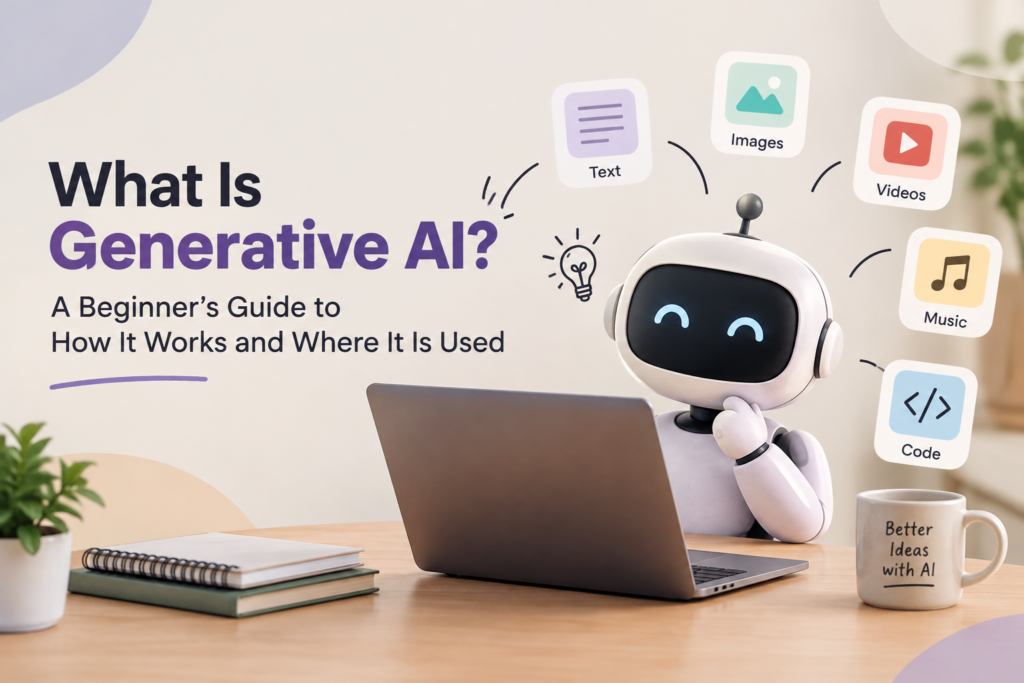
Generative AI is a type of artificial intelligence that can create new content, such as text, images, videos, music, computer code, and more, based on instructions or prompts provided by users.
In simple words, generative AI works like a creative assistant. You tell it what you need, and it generates a response based on patterns it has learned from training data.
For example, you can ask an AI tool to:
- Write an Instagram caption for a fashion brand.
- Create a blog outline about digital marketing.
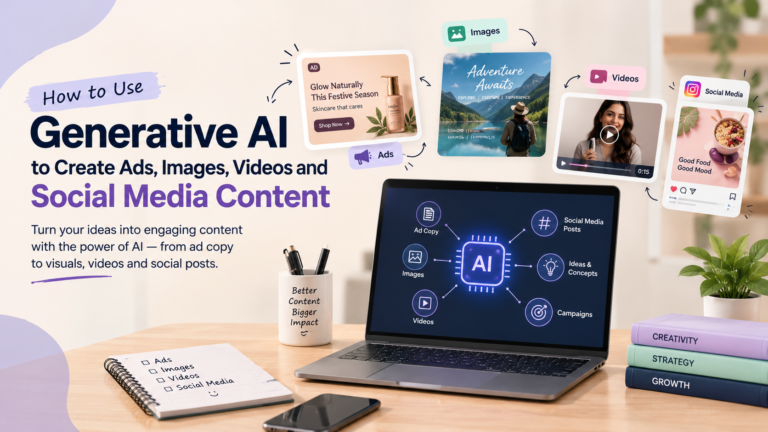
- Generate an image for an advertising campaign.
- Summarise a lengthy document.
- Suggest business names for a new startup.
Tools such as ChatGPT, Google Gemini, and image-generation platforms demonstrate how generative AI can support everyday tasks.
Unlike traditional software that follows predefined rules to perform specific actions, generative AI can produce different outputs depending on the instructions, context, and information provided. However, its responses are not always accurate or original in the legal sense. Human review remains important.
How Does Generative AI Work?
Understanding how generative AI works becomes easier when you break the process into a few simple steps.
1. Learning From Data
Generative AI models are trained using large collections of data, which may include text, images, code, audio, and other information, depending on the model. During training, the model learns patterns, relationships, structures, and associations within that data. For example, a language model learns how words and sentences commonly fit together. An image-generation model learns relationships between visual features and descriptions.
2. Understanding Your Prompt
A prompt is the instruction or question you give an AI tool. For example, instead of writing, “Give me content,” you could write, “Create five Instagram captions for a skincare brand targeting college students.” The second prompt gives the AI more context about the task, audience, and expected output. The clearer your instructions, the easier it is to guide the tool towards a useful result.
3. Generating New Content
Once you submit a prompt, the model processes it and generates a response. Language models typically predict and generate sequences of tokens, which may represent words, parts of words, or other text units. Image-generation models use different techniques to create visuals from learned patterns. The result is new content generated in response to your instructions.
4. Reviewing and Improving the Output
AI-generated content should not automatically be treated as final. You can refine the result by asking follow-up questions, changing the tone, adding details, or correcting errors. For example, you could ask an AI tool to make a blog more conversational, simplify technical terms, or adapt its language for a particular audience. This process of giving instructions, reviewing results, and refining outputs is an important part of using generative AI effectively.
Where Is Generative AI Used?
Generative AI is useful across many industries. Here are some common applications beginners should know about.
1. Digital Marketing and Content Creation
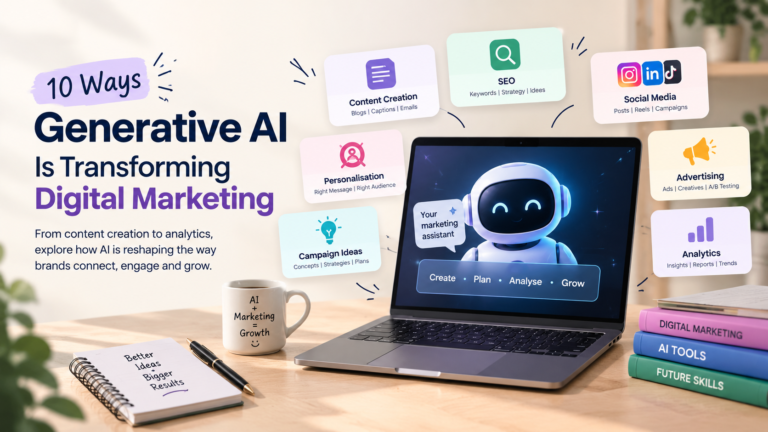
Digital marketers use generative AI to support content planning, copywriting, campaign brainstorming, and creative production. For example, an AI tool can help generate blog ideas, draft email campaigns, suggest Google Ads headlines, or create social media content calendars. A marketer can also use AI to explore different creative approaches for the same campaign. However, marketers still need to understand their audience, brand voice, SEO strategy, and campaign objectives. AI can assist with execution, but effective marketing requires human judgement.
2. Education and Learning
Students can use generative AI to understand difficult concepts, create revision notes, practise questions, and organise their study schedules. For beginners learning a new subject, AI can explain complex topics in simpler language. For example, a student learning search engine optimisation can ask an AI assistant to explain keywords, backlinks, and search intent using everyday examples. Students should verify important information and follow their institution’s academic integrity guidelines.
3. Business and Customer Support
Businesses can use generative AI to draft customer responses, prepare reports, summarise meetings, and develop ideas for products or services. When combined with suitable business systems, AI can also support customer-service workflows and help teams respond more efficiently. For small businesses, these capabilities can reduce repetitive work and free up time for planning, customer relationships, and business growth.
4. Design and Visual Content
Generative AI tools can create visual concepts from text descriptions. Designers and marketers may use them to explore campaign visuals, mood boards, product concepts, and creative directions. For instance, a café launching in Mumbai could use an image-generation tool to explore interior design ideas before finalising its actual design. AI-generated visuals may still require editing, quality checks, and attention to copyright, licensing, and brand requirements.
5. Software Development
Developers can use generative AI to draft code, explain programming concepts, identify possible errors, and document software. Beginners can also use AI as a learning assistant when practising programming. However, generated code must be tested carefully because it can contain bugs, security weaknesses, or incorrect assumptions.
What Are the Benefits of Generative AI?
Generative AI offers several practical advantages when used responsibly.
Saves time: It can help create first drafts, summarise information, and brainstorm ideas faster.
Encourages creativity: It can suggest alternative approaches when you need inspiration.
Supports personalised learning: Users can request explanations suited to their knowledge level.
Improves productivity: It can assist with repetitive writing, research organisation, and selected routine tasks.
Makes technology more accessible: People without advanced technical skills can begin exploring AI through simple, everyday prompts.
The real value comes from combining these capabilities with your own knowledge, creativity, and decision-making.
What Are the Limitations of Generative AI?
Although generative AI is powerful, it is not perfect.AI tools can produce inaccurate information, sometimes called hallucinations. They may misunderstand instructions, reflect biases present in their training data, or generate content that sounds convincing but lacks factual support.
Privacy is another important consideration. Avoid entering confidential business information, sensitive personal details, or private customer data into tools unless their data-handling policies and your organisation’s rules permit it.
Copyright and intellectual property concerns also matter, particularly when using generated images, text, or other creative work commercially.
Most importantly, generative AI does not replace human responsibility. Always fact-check important claims, review outputs, and use your judgement before publishing or acting on AI-generated information.
How Can Beginners Start Learning Generative AI?
You do not need to be a programmer or have an advanced technical background to begin exploring generative AI.
Here are five practical steps to get started:
Understand the basics: Learn what AI, machine learning, and generative AI mean.
Explore AI tools: Experiment with tools such as ChatGPT and Google Gemini.
Practise prompt writing: Give clear instructions, specify your audience, and describe the output you want.
Work on small projects: Create a sample blog, social media campaign, presentation, or visual concept using AI.
Build practical skills: Learn how to combine AI with digital marketing, content creation, analytics, and workflow automation.
The goal is not simply to learn which tools are available. It is to understand when to use them, how to evaluate their outputs, and how to apply them to real-world problems.
Learn AI and Digital Marketing Skills with IIEDM
As AI becomes increasingly relevant to modern workplaces, learning how to use it alongside practical digital skills can help students and professionals explore new career opportunities.
At IIEDM, learners can explore AI-driven digital marketing education alongside practical training in areas such as SEO, social media marketing, paid advertising, and content creation. The institute highlights industry-oriented learning and hands-on project experience as part of its approach.
Whether you are a college student, a fresher exploring career options, a working professional, or someone interested in digital marketing, developing a strong foundation in these areas can help you understand how technology is applied in business.
To explore available courses and find a learning path that suits your goals, visit IIEDM’s official website.
Conclusion
Generative AI is changing how people create content, learn new skills, solve problems, and approach everyday work. From writing and design to marketing and software development, its applications continue to expand.
For beginners, the best way to understand generative AI is to start small, experiment with different tools, practise writing effective prompts, and learn to evaluate the results critically. AI is most useful when it complements human creativity, knowledge, and judgement rather than replacing them.
Ready to explore the future of AI and digital marketing? Start building your skills with IIEDM and take your first step towards understanding the technologies shaping tomorrow’s workplace.